
Custom Brass Jewelry: Design Limits Worth Knowing
Most design problems on a plated brass piece are decided long before the tank: a setting that has nothing to hold, an engraving that vanishes under a plate, a clasp that pulls on a hollow form. The published process gives you 48 hours for 3D CAD, 25–30 days for sampling and eight named factory steps, on a minimum of 100 pieces per design for artisan eco-brass. Here is where the limits actually sit.

Key takeaways
- Six customisation options are available per order, from base material to packaging and barcodes.
- Hallmarks are the S925 hallmark, a 316L mark on steel and an 18KGP mark on plated work, and they are dimensional features set at the CAD stage.
- Sampling runs 25–30 days over five named operations, so a design fix mid-window costs five to six days.
- Eco-brass minimums sit at 100 pieces per design, against 50 for 925 sterling silver.
Where a design usually fails before it reaches the tank
The first limit is setting geometry. A stone needs metal around it that is thick enough to be pushed over the girdle and thick enough to hold after polishing, and polishing removes material. A setting drawn tight to the edge of a pendant may look correct on a render and lose its grip two operations later, which is why setting and polishing sit next to each other in the published step list.
The second limit is engraving. Laser engraving is a cutting process, and a logo with fine hairlines or a very small hallmark needs enough surface area to read. On a plated piece the cut also exposes the metal underneath, so a mark placed on a visible face is a permanent design decision rather than a detail.
Wall thickness, hollows and the weight of a brass piece
Brass is a working metal rather than a precious one, which makes hollow forms tempting for a lighter, cheaper-feeling piece. The trade is structural: a hollow pendant leans on its own wall thickness to keep its shape through polishing and plating, and a thin wall can deform while it is being handled on the bench. Solid forms behave predictably.
This is the point where the CAD stage earns its 48 hours. A drawing lets you see where the material is and where it is missing before a mould is cut, and a change at that stage costs screen time rather than a new tool. By contrast, a change to wall thickness after sampling is a new tooling cycle, and the same five sampling operations run again from the start.
Chains, findings and movement in a finished piece
The third place a design hits a limit is at the joints. Chains and findings are listed as a customisation line of their own, and a pendant's weight has to match the finding that carries it. A heavy brass pendant on a fine chain puts all the load on one jump ring, and the ring is the smallest plated part on the piece, so it is also the one where a coating wears through first.
The same applies to earring posts and clasps: these are the parts that flex, twist and rub, so they take more abuse than any decorative surface. Specifying them as their own line in the tech pack, rather than as an assumed detail, is the difference between a sample that works and a sample that works once.
| Item | Published figure | Design consequence |
|---|---|---|
| 3D CAD modelling | Under 48 hours | Shape changes are cheap only here |
| Master sampling | 25–30 days, five operations | A setting or finish fix costs 5–6 days each |
| Mass production | 3–4 weeks | The mould is already committed by now |
| Customisation lines | 6 options per order | Each one is a separate approval |
What the six customisation options really decide
Stones and accents, plating and finishes, the base metal, findings and chains, hallmarking and logo and packaging specification: each is a decision with its own deadline, and three of them are drawing-stage items. Base material sets the minimum and the finishing route. Stones and accents set the setting geometry. Logo and hallmarks set the engraving.
The remaining three are production-stage items. Plating is a finish specification, chains and findings are sourced goods, and packaging is printed separately from the jewelry. Base material also sets the MOQ, so it is the first line to settle. A design review that covers all six at once usually takes one meeting; discovering them one at a time takes a full sampling window each.
Reading a catalogue with the limits in mind
A catalogue is a good place to find shapes that already work in production, and a poor place to check whether a specific design is buildable. The useful exercise is to open the finishes against the specification: gold plating in 14K, 18K and 24K, rhodium for white metal, the anti-tarnish e-coating over silver and brass, PVD on stainless steel, and the S925, 316L and 18KGP hallmarks that go with them.
Anything that shows a stone setting, an engraved mark or a chain is showing the results of decisions that were made at CAD stage. If you view catalog shapes with an eye on the joins rather than on the silhouette, the same limits show up in the finished product and can be specified before tooling.
Design against the alloy, not against a swatch
The material is a premium alloy of copper and zinc, and its behaviour at the bench sets most practical limits: it takes a high-gloss polish, it accepts multi-layer gold or rhodium plating, and it can be darkened with an oxidation or antique finish instead of a bright plate. Nickel content is stated as meeting certified standards, and the line conforms with REACH and California Prop 65.
, so the second design costs another 50 to 100 pieces. Sharp internal corners hold plating unevenly, so radii help both the finish and the polishing stage. And if a collection is meant to look hand-finished, an antique treatment hides more of the small surface variation that a high-gloss plate would exaggerate. The metal is 100% recyclable, so a rejected casting is not the dead end a brand might assume.
Worked example: the development windows in hours
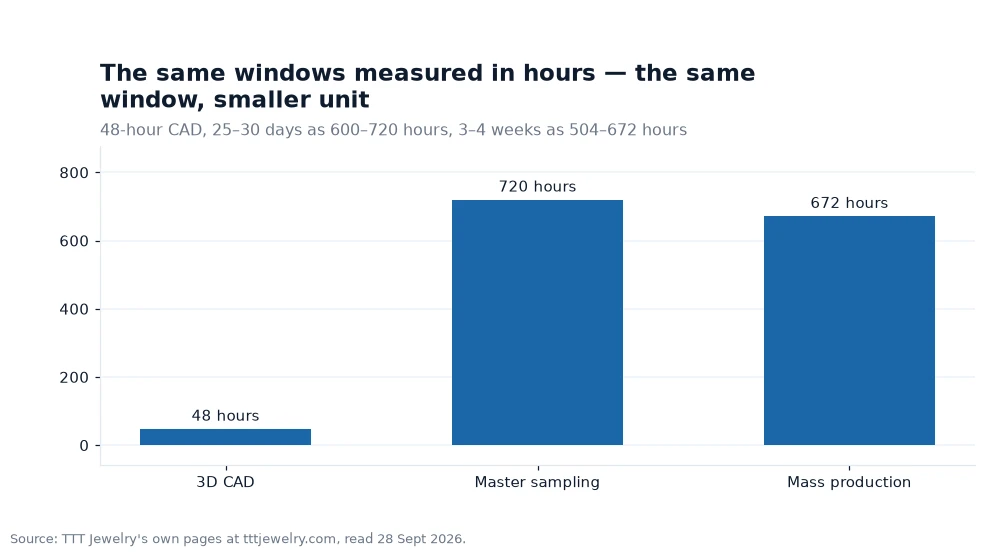
Hours make the sampling block look different. CAD at under 48 hours is 48 hours. Sampling at 30 days is 30 × 24 = 720 hours. Production at 4 weeks is 28 × 24 = 672 hours. Added together, the slow path is 48 + 720 + 672 = 1,440 hours, which is 1,440 ÷ 24 = 60 days.
Now compare the ratio. Sampling is 720 ÷ 1,440 = 50% of the whole chain, while the CAD stage that decides everything downstream is 48 ÷ 1,440 = 3.3%. The arithmetic is mine; the 48 hours, 25–30 days and 3–4 weeks are the published windows. The point of the sum is that design work is cheap in hours and expensive in days.
Frequently asked questions
Can a design be changed after the sample is made?
Yes, but the sampling work repeats: the same five operations run again over 25–30 days, because a change alters the mould rather than only the finish.
Which markings are available on a finished piece?
Laser engraving for logos, and the published purity hallmarks S925 for sterling silver, 316L for stainless steel and 18KGP for gold-plated goods.
What is the smallest quantity for a first brass design?
Artisan eco-brass starts at 100 pieces per design; 925 sterling silver is the lower floor at 50 pieces per design, and stainless steel sits at 100+.
Specifying a design that survives its own process
Draw the joins before drawing the silhouette. The setting, the post, the jump ring and the hallmark position are the four places a piece fails in use, and each one can be specified while the model is still on screen. Then ask the factory to confirm three things in writing: the coating sequence, the engraving depth and the finding specification. Taken together, they decide whether the finished piece matches the sample a month after launch. The six customisation options exist so those answers are recorded per order rather than remembered per conversation, and if the design leans on stones or pearls, the stone and pearl programs are where those accents are specified. The same three answers are also covered on the eight-step factory tour, which lists the operations each of them belongs to.
Everything factual here — the gold and rhodium plating layers, then the anti-tarnish e-coating plus the REACH and California Prop 65 compliance — comes from the client's own website at the tttjewelry.com address, read in full on 28 Sept 2026. The restatement in hours is mine, not the site's[1].